
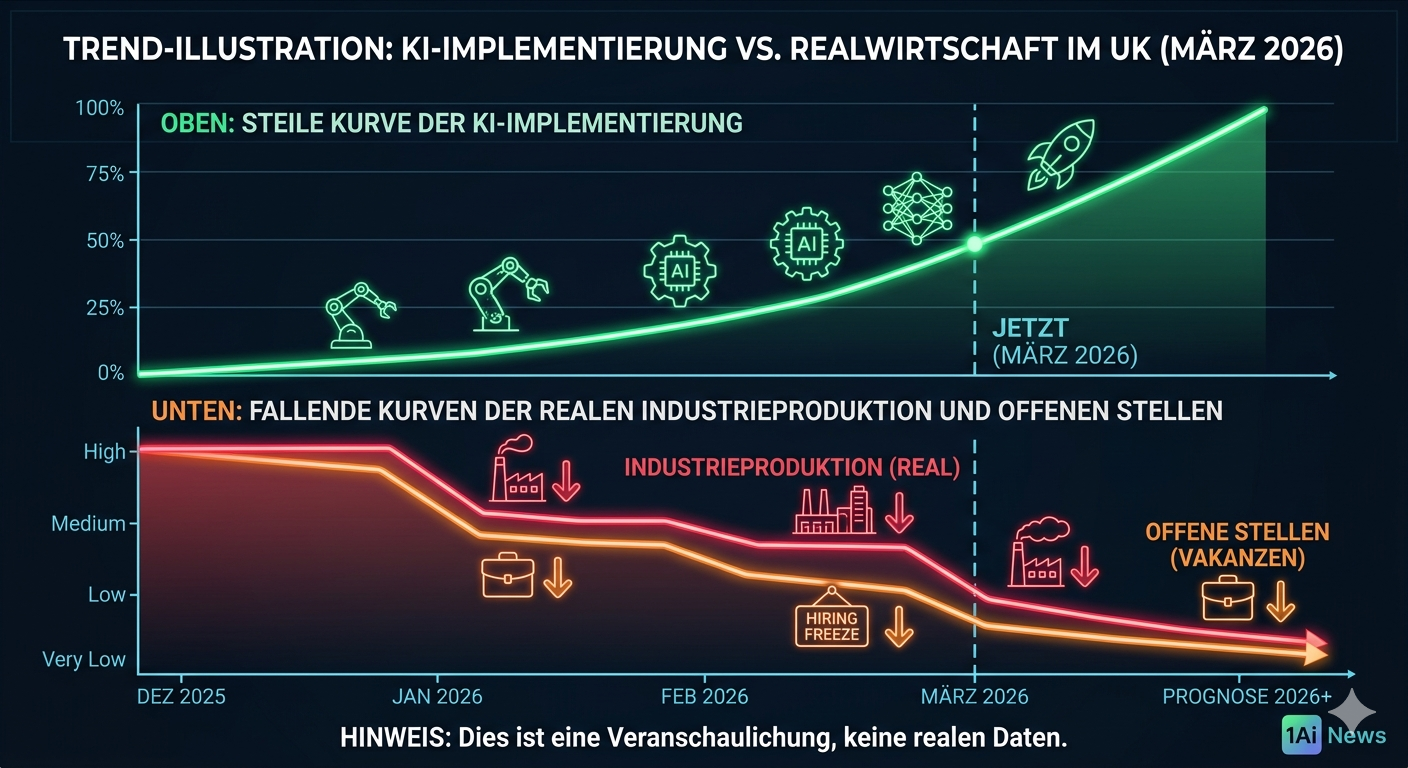
At 1AI News We often look at the fascinating possibilities of artificial intelligence. But today we have to talk about part of the downside that is emerging in Great Britain (UK). It is a development that shows that AI is not only used as a tool, but also as a radical savings factor. Since there are some parallels to the economic development in Germany, we would also like to examine this aspect.
If you look at the stock market prices at the moment, you might think that the world situation is not that dramatic. The indices have been rising for years, and even escalating conflicts, even constricting the global oil flow, does not seem to reflect the feared forecasts of such events. What happened unnoticed at the same time, however, is the K.I. Agent Revolution that has just entered. This combination of economic activism and technical progress could turn out to be the ‘perfect storm’ that can lead to a larger economic tremble than it currently seems.
Already a first look shows parallels to Germany. The drop in employment due to high energy costs. In the UK, energy costs have risen significantly due to the current world situation (Middle East War and the restrictions in the Strait of Hormus). England does not have large storage for oil and gas, which is why the world situation here is even more noticeable here than is currently the case in Germany.
Companies hire less or stop new hires at the moment to remain liquid. The high energy costs in Germany have long been a permanent issue and also lead to insolvencies or recruitment stops to avoid redundancies for operational reasons.
Now American high-tech companies like Nvidia are investing massively in the expansion of K.I. agent systems, which have the potential to completely replace newcomer jobs. ( see article )
Companies in the UK are therefore forced to use these systems, for reasons of profitability, which has negative effects on the labor market. The unemployment rate is already high at a 5 year, and expectations suggest a further tightening. (as of 03/18/2026)
Youth unemployment aged 16 – 24 is currently at a level of 15.9% (from 14.4% 2024) which is driving serious discussions about an unconditional basic income in English politics and business.
Author’s note:
Germany’s politics should take this development seriously. The high energy costs and the lack of the announced economic recovery and the current K.I. agent development will also require early action in this country. ‘Part-time lifestyle’ debates or the demand to work longer during the week or the old age are of little help here.
Conclusion:
England is the experimental laboratory. What is happening there – the decoupling of the financial markets from real work through AI-supported cost reductions – could be the blueprint for the rest of Europe and especially Germany if energy prices remain high.
Sources:
Unconditional basic income (UBI):
https://autonomy.work/welfare/
https://www.ubilabnetwork.org/
https://www.gov.scot/publications/minimum-income-guarantee-roadmap-dignity/pages/7/
Unemployment figures at the age of 16 – 24
https://commonslibrary.parliament.uk/research-briefings/sn05871/
Addendum: > Shortly after this article was published, Germany’s Digital Minister confirmed the shift towards AI-driven job displacement and the necessity of a Universal Basic Income (UBI).
https://www.spiegel.de/politik/kuenstliche-intelligenz-digitalminister-karsten-wildberger-fuerchtet-branchenwandel-und-jobverluste-a-07c3a69d-add8-4e95-bd17-29237f8a4edd
Editor’s note: This article shows the author’s personal assessments and logical conclusions based on publicly available data and reports. It expressly does not represent any economic or investment advice. No liability is assumed for the correctness of the forecasts in a rapidly changing world situation.