
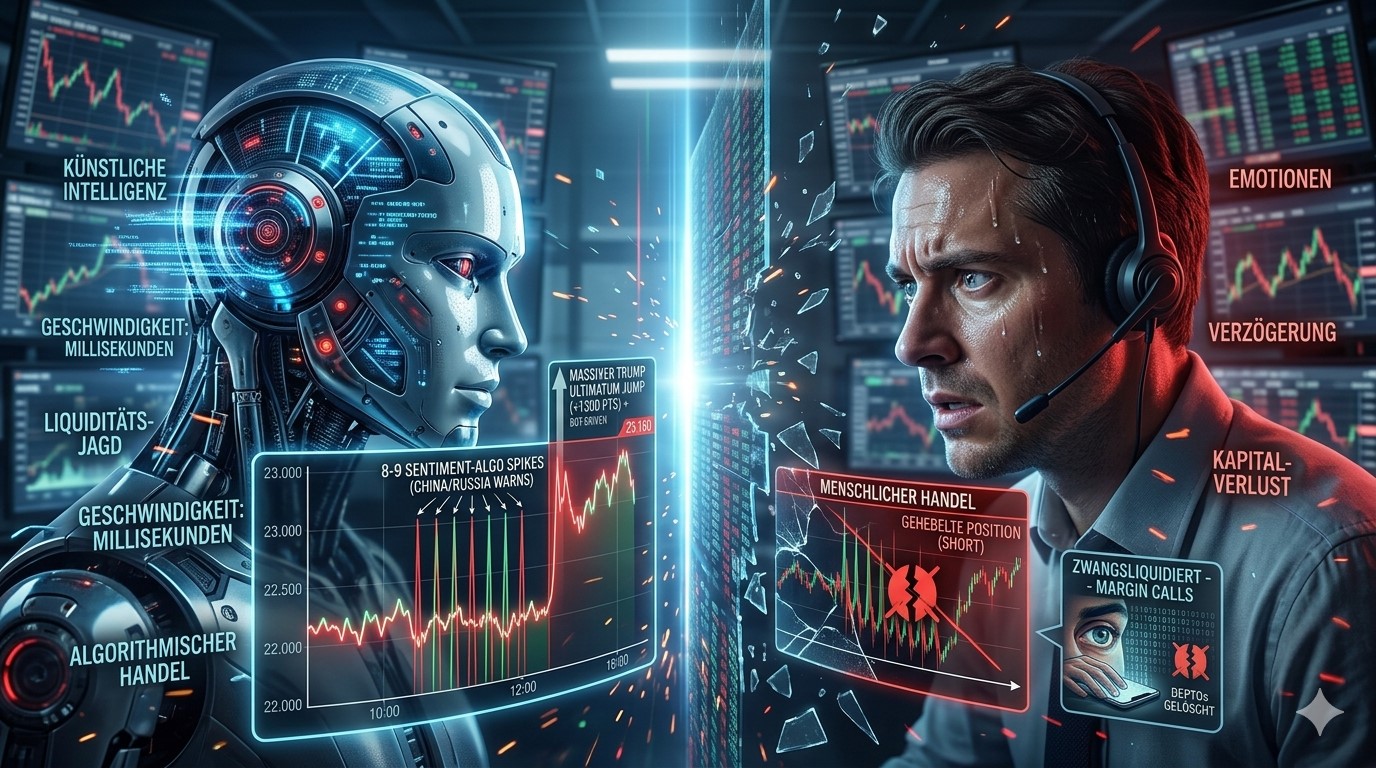
The flickering before the storm: when the stock market loses its orientation
Yesterday, March 23, 2026, will go down in history as the day when the DAX stopped being a clinical thermometer of the economy and instead adopted the behavior of a defective spotlight. It was a technological heart flutter that was incomprehensible to human observers.
It all started with the first reports about the warnings from China. At that moment something strange happened: the course didn’t just rise, it ‘flickered’. Within a fraction of a second, the Dax shot up by about 300 points, only to fall back exactly to the starting point in the next moment. It was as if someone in a dark room would turn the light on and off every second. Day, night, day, night.
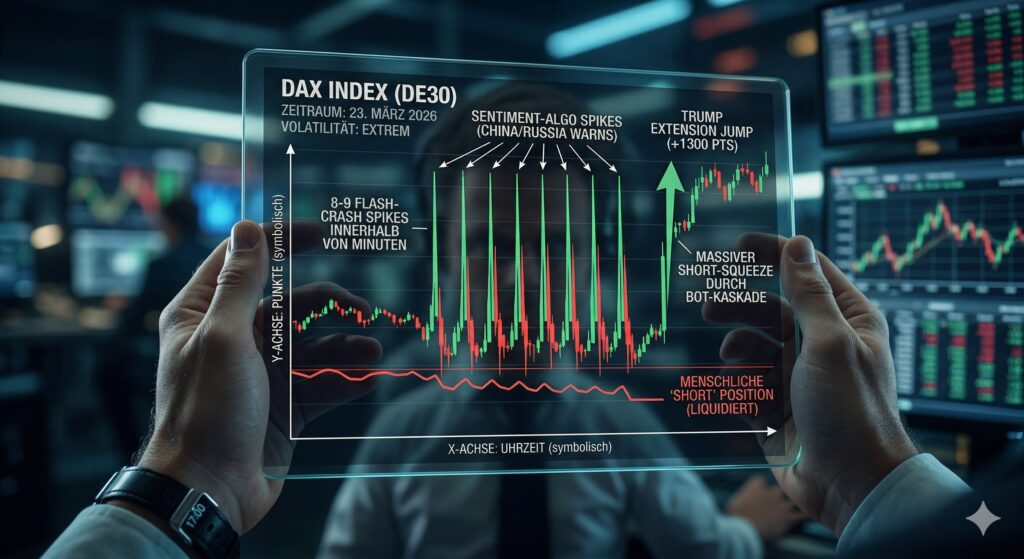
These ‘needle impulses’ were repeated four times. Shortly thereafter, the warnings from Russia ran over the tickers, this digital trembling continued – the market twitched another four to five times as if under electric shocks.
But all that was just the foreplay.
When the news of Donald Trump’s postponement of the ultimatum arrived, all dams broke. The German stock market history has never seen what followed: an almost absurd jump of over 1,300 points. It was no longer a normal price increase, but an explosion. In a time window in which a person just finished the headline, hundreds of thousands of bots had already decided that the ‘night’ was over and that the ‘sun’ was shining with full force.
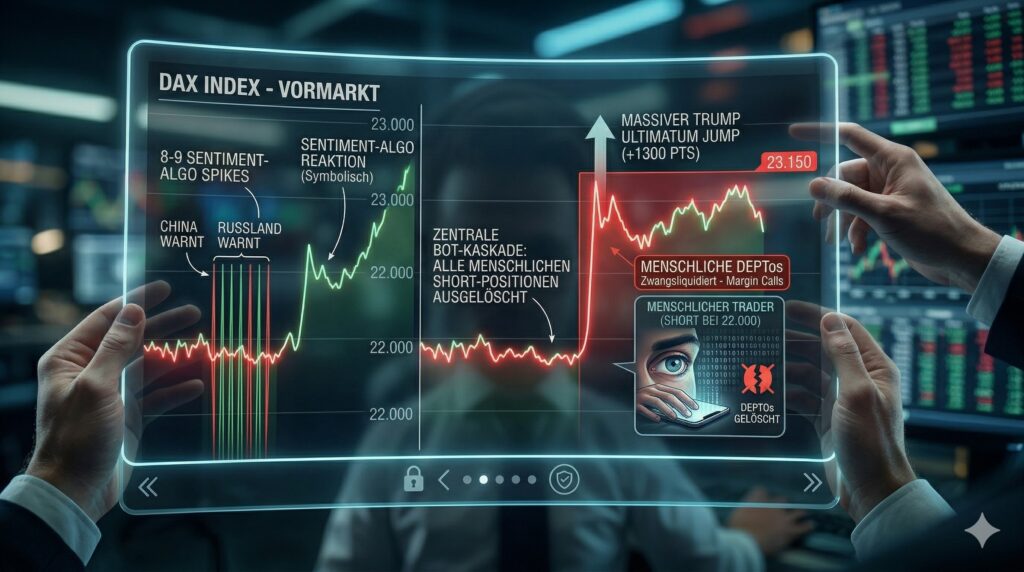
What was just the logical consequence of a programmed chain of command for the algorithms meant the end for the human trader. Anyone who was driving here in sight, who tried to act with intuition or calm, was simply left blindly behind by this lightning-like change between total darkness and glistening light.
Information on the DAX, maximum and lows from 23.03.2026:
| 03/23/2026 | Closing: 22,653.86 | Opening: 21,947.82 | Highest level: 23,178.70 | low: 21,863.81 |
The ‘Lever’: How a small gust of wind tears your entire house
Many people today use apps like plus500, eToro Oder capital.comto act quickly and easily on the go. These platforms often advertise that you can “get big” even with small amounts. The magic word here is: Lever.
What sounds so technical is in fact a gigantic loan. For example, if you 500 € have in your depot and with a Lever of 20:1 Put on the DAX, they move in reality €10,000 on the market. The broker lends you the rest €9,000.
The problem: The lever works in both directions.
Suppose you put in the current news situation 500 € on falling courses.
- If the price drops now 1%, you made 20% profit. A great feeling.
- However, the price increases 5% (which was even surpassed yesterday within a few seconds), your total equity of 500 € is lost!
The Math of Failure
Why Daytrading becomes an Illusion for People
There used to be phases in which people could react to trends as a person. You saw a message, thought briefly and acted. Today they are fighting against algorithms that don’t know a ‘second moment’.
Platforms that are popular with young people in particular make this highly risky game as easy as a video game. But behind the colorful charts and easy-to-use buttons is a merciless mechanic:
- 60% to 70% of all private investors lose money on these bets.
- In moments like yesterday, when the bots whip the prices for 1,300 points, this rate may still rise above.
Conclusion: The hiccups before the collapse?
The most frightening thing about yesterday’s events is not the jump of 1,300 points per se. It is the indifference with which the financial world dismisses it. Ten years ago, such an event would have dominated the headlines for weeks; Today it is dismissed as a technical detail, as a mere ‘hiccup’ in the system. We got used to the abnormal.
But we have to honestly ask ourselves: What else does a stock market index like the DAX actually depict? Originally, it was supposed to reflect the economic strength and expectations of our companies. But if a single sentence from a politician is enough to trigger an avalanche of algorithms that whips up the value of the entire German market by billions in minutes by billions, that has nothing to do with reality in the factories and offices. No values were created – only numbers in a database were moved.
The danger of the digital tipping point
If we accept this condition as ‘normal’, we are moving towards a dangerous tipping point. At the moment, the bots seem to be programmed to buy immediately, no matter how vague hopes. This inflates the system more and more, decoupled from the real world. But what happens when this chain reaction turns in the other direction?
There are so-called ‘trading dropouts’ (circuit breakers) on the stock exchanges, which should pull the plug if it goes downhill too quickly. But in a world where hundreds of thousands of bots operate in milliseconds, these fuses could simply blow like old fuses in a high-voltage plant. Once the machines go into panic mode and beat each other with sales orders, a chain reaction could occur that can no longer be easily stopped by closing a browser window.
Yesterday was a warning. Anyone who believes that steadily rising prices in a burning world is a sign of stability succumbs to a dangerous error. We watch a system dancing that has long since lost the ground beneath our feet. And it’s time for us humans to ask us if we really want to be in the front row with this dance.
Editor’s note: This article shows the author’s personal assessments and logical conclusions based on publicly available data and reports. It expressly does not represent any economic or investment advice. No liability is assumed for the correctness of the forecasts in a rapidly changing world situation.